FUE Hair Transplant Pune has become one of the most preferred hair restoration solutions for individuals seeking natural-looking, permanent results with minimal downtime. Using advanced techniques and precise graft extraction, FUE offers an effective solution for treating hair loss while preserving the appearance of the donor area.
The journey to tackle hair loss is a deeply personal one, and deciding on a hair restoration method is a significant step. Today, the most widely accepted and popular technique is Follicular Unit Extraction (FUE). FUE involves meticulously extracting individual hair follicles from a dense donor area and transplanting them into the thinning or balding recipient areas. This approach has set a high standard in modern hair restoration due to its ability to deliver natural-looking results and minimal scarring.
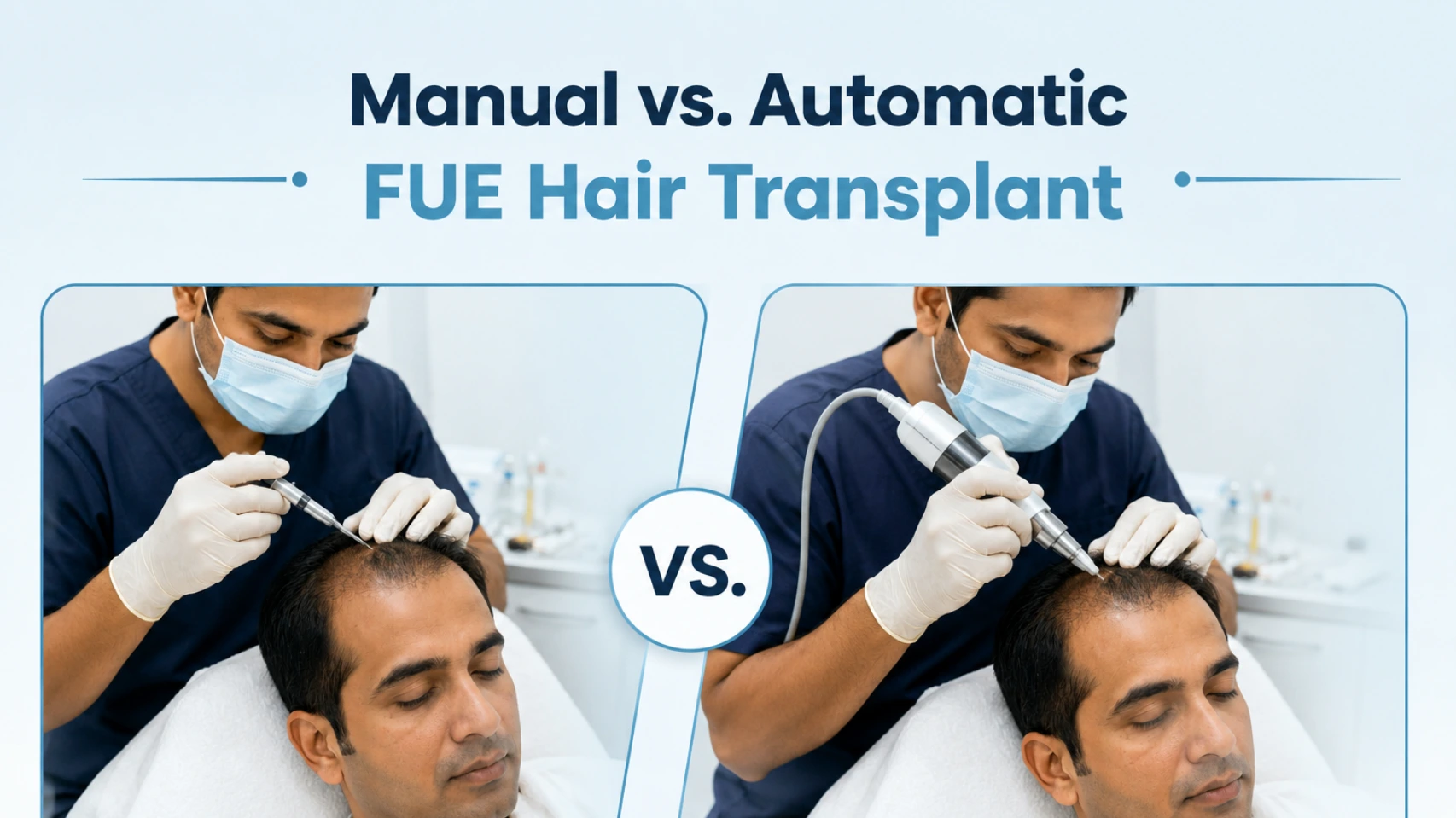
However, not all FUE procedures are identical. The fundamental difference lies in the mechanism used to harvest the grafts: whether it is performed manually by the surgeon or with the aid of automated technology. Understanding the core differences between Manual FUE and Automatic FUE is crucial for making an informed choice.
Is Hair Transplant Permanent, Hair transplant growth after surgery, Hair Transplant In Pune, dr. kiran chotaliya clinic, Is Hair Transplant Permanent, Hair transplant growth after surgery, Hair Transplant In Pune, dr. kiran chotaliya clinic,Is Hair Transplant Permanent, Hair transplant growth after surgery, Hair Transplant In Pune, dr. kiran chotaliya clinic
FUE Hair Transplant Pune offers both manual and automatic techniques, with the primary difference being the method of graft extraction while both aim to deliver natural-looking, long-lasting hair restoration results.
Manual FUE: The Art of Precision
In the Manual FUE hair transplant in Pune, the surgeon utilizes a small, handheld punch tool, typically measuring between 0.6 mm and 1.0 mm in diameter, to manually extract each follicular unit one by one. This highly skilled procedure demands exceptional precision, patience, and expertise, helping achieve natural-looking results while preserving the donor area.
Automatic FUE: Technology Meets Efficiency
Automatic FUE hair transplant in Pune utilizes a motorized or robotic device to assist the extraction process. While the surgeon maintains full control and guides the device, the tool automates the rotational movement of the punch. This advanced approach is designed to increase efficiency, enabling faster harvesting of a large number of grafts while reducing the overall procedure time and improving patient comfort.
Many experts regard manual FUE as the most artful approach to hair restoration. The defining element of this technique’s success is the surgeon’s personal touch.
A key advantage of Manual FUE is the complete control the surgeon has over the angle, depth, and direction of every single extraction. This level of microscopic control is particularly beneficial when handling delicate or naturally curved hair follicles.
The advantages of choosing Manual FUE include:
Maximum Graft Quality:
The ability to adjust the angle of the punch for each individual graft helps ensure a lower rate of transection (damage to the follicle during extraction).
Targeted Graft Selection:
A skilled surgeon can carefully select the healthiest multi-hair grafts, which significantly contribute to achieving a denser, more natural appearance in the recipient area.
Reduced Over-harvesting:
Because the pace is slower, the surgeon can more carefully monitor the donor area. This ensures uniform density is maintained across the back of the head, thereby avoiding visible thinning.
Manual FUE is often preferred for those who require a smaller number of grafts for highly precise procedures, such as specific hairline reconstruction or eyebrow restoration, or for patients with challenging hair characteristics, like curly hair.
Automatic FUE systems were primarily developed to overcome the physical limitations and duration associated with the manual technique. The motorized punch dramatically accelerates the speed of the extraction process.
Evidence suggests that motorized FUE can reduce operative time by up to 30% compared to the manual method without negatively impacting graft quality. However, it is crucial to remember that even with automation, the device still requires a highly skilled operator. The surgeon’s expertise in controlling the automatic tool is essential to prevent potential graft damage.
The decision between manual and automatic FUE is a personal one that must be made after a detailed consultation with a qualified hair transplant surgeon.
Here are the key factors that should be discussed to determine the best technique for you:
| Feature | Manual FUE | Automatic FUE |
|---|---|---|
| Graft Harvest | Handheld punch, controlled solely by the surgeon | Motorized or robotic device |
| Speed | Slower and more labor-intensive | Faster and more efficient |
| Best For | Smaller sessions, complex hair types, hairline precision | Large sessions, extensive hair loss |
Extent of Hair Loss:
For patients with extensive baldness, an automatic FUE procedure might be a more efficient path to harvest the required large number of grafts. Conversely, for smaller, highly targeted areas, manual FUE often offers the necessary precision.
Donor Hair Characteristics:
If your hair is challenging—be it straight, wavy, or curly—a surgeon’s manual control may be more effective in handling the hair shaft angle and minimizing transection (damage).
Surgeon’s Expertise:
This is arguably the most crucial factor. A highly skilled and experienced surgeon can consistently produce excellent results with either the manual or the automatic technique. Always prioritize choosing a reputable establishment with a proven track record.
High satisfaction is reported by a significant portion of hair transplant patients (90–95%). Remember, the overall success of the transplant relies not just on the specific extraction technique chosen, but on a combination of factors, including precise surgical planning, detailed pre-operative consultation, and meticulous aftercare.
Choosing between manual and automatic FUE hair transplant depends on your hair characteristics and restoration goals. Consulting an experienced hair transplant specialist in Pune helps determine the most suitable technique for achieving natural-looking, long-lasting results.
If you are considering a FUE Hair Transplant Pune, consulting with an experienced specialist can help you make an informed decision and achieve long-lasting, natural hair restoration results.
The success rate of FUE is generally very high. When performed by an experienced and qualified surgeon, graft survival rates typically range from 85% to 95%.
No, the procedure is performed under local anesthesia, meaning you should not feel any pain during the surgery itself. Any post-operative discomfort is usually minimal and can be effectively managed with prescribed pain medication.
Recovery is relatively quick. Most patients feel ready to return to light activities and work within 2–5 days. The donor area typically heals within about a week, and any visible redness or scabbing in the recipient area usually disappears within 7–10 days.
While you will begin to observe new hair growth in the initial months, achieving the final, dense results requires patience. The results can take up to 12–18 months to fully mature.
FUE Hair Transplant Pune is an advanced hair restoration procedure in which individual hair follicles are extracted from the donor area and transplanted into thinning or bald areas. It provides natural-looking, permanent results with minimal scarring and faster recovery compared to traditional hair transplant techniques.
A hair transplant specialist Pune can assess your hair loss pattern, donor area, and treatment goals to recommend the most suitable surgical or non-surgical hair restoration solution.

A free experts curated guide that clears all your doubts
about Costs, Results, Pain, Recovery and much more.
Dr. Kiran Chotaliya is a leading hair transplant surgeon in Pune, specializing in advanced techniques like FUE and FUT for natural, lasting results. His expertise and patient-centered care ensure successful hair restoration with exceptional outcomes.
© 2026 Developed & Handle By Dr. Kiran Chotaliya Clinic Team
© 2026 Developed & Handle By Dr. Kiran Chotaliya Clinic Team