
A full, well-shaped beard is often associated with a strong and confident appearance. However, not everyone can naturally grow the beard they want. Genetics, patchy beard growth, facial scars, or certain medical conditions can leave some men with uneven facial hair.
A beard hair transplant offers a long-term solution by restoring facial hair in areas where growth is limited or absent. One of the most common questions patients ask before undergoing the procedure is: “How many grafts will I need to achieve the beard style I want?”
The answer varies from person to person. Factors such as your current beard growth, facial structure, hair characteristics, and desired density all play a role in determining the number of grafts required.
Quick Summary
Most beard hair transplants require between 1,200 and 3,500 grafts. Minor patchy beard correction may need only 500–1,000 grafts, while a full beard transplant typically requires 2,500–3,500+ grafts to achieve natural-looking coverage and density. The exact number depends on factors such as facial structure, existing beard growth, hair thickness, and individual aesthetic goals.
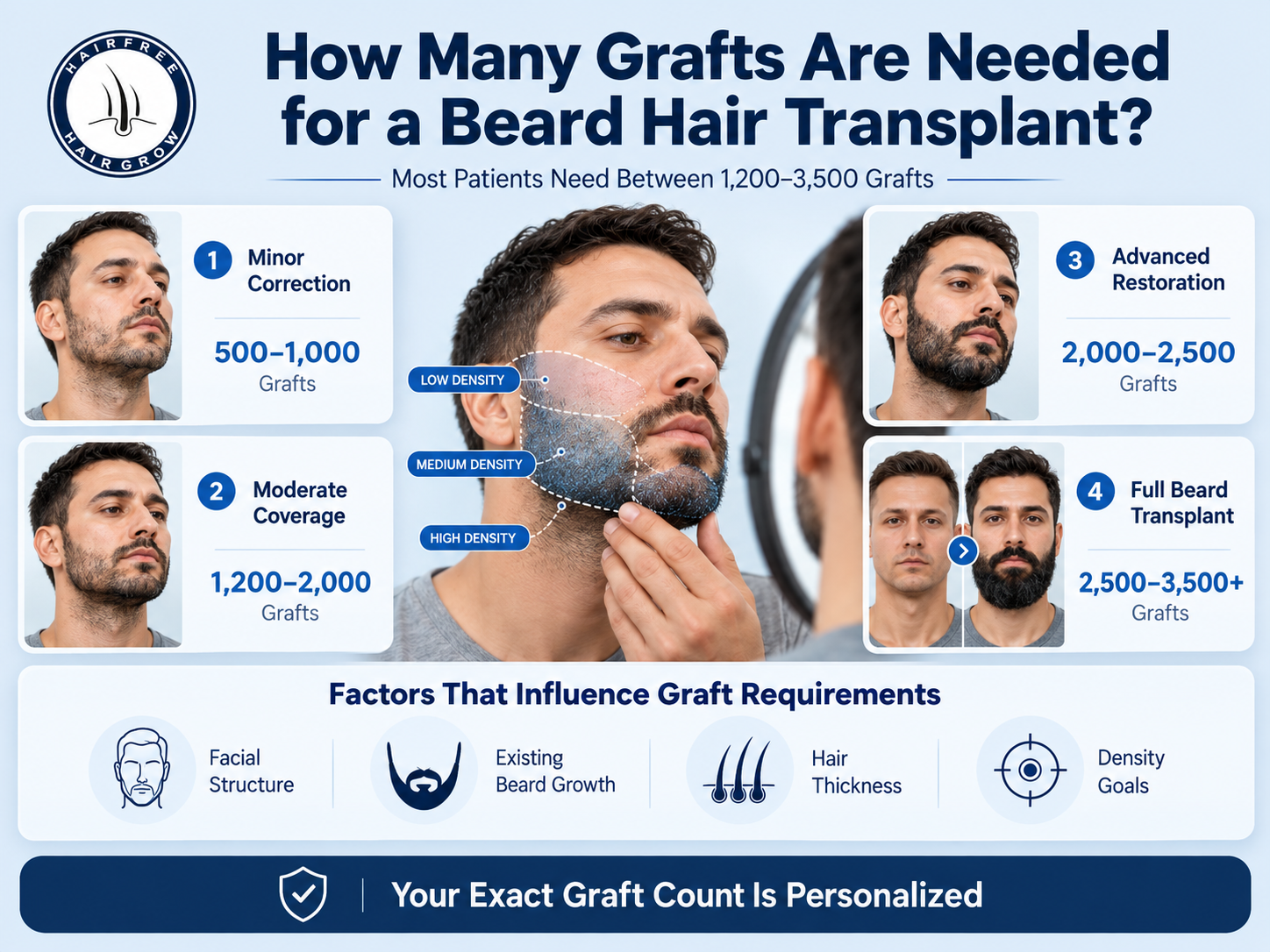
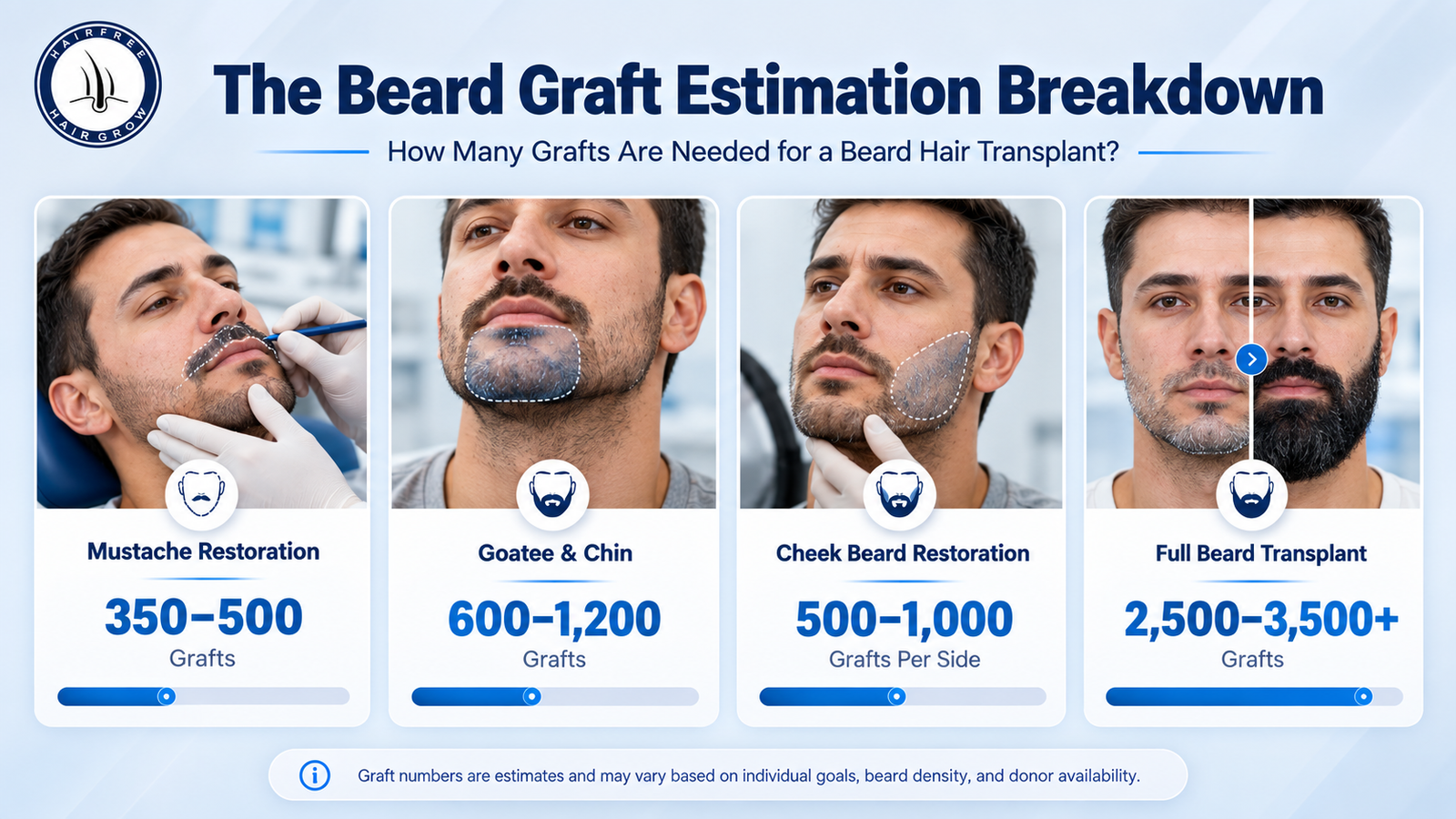
The number of grafts needed depends largely on which part of the beard is being restored. Below are general estimates used during treatment planning.
1. Mustache Restoration (350–500 Grafts)
A mustache transplant generally requires a relatively small number of grafts. However, achieving a natural result requires careful placement, as mustache hairs grow at specific angles and are highly visible.
2. Goatee and Chin Area (600–1,200 Grafts)
Patients with weak or patchy growth around the chin often choose goatee restoration. This area typically requires higher density because it forms a central feature of the beard.
3. Cheek Beard Restoration (500–1,000 Grafts Per Side)
Sparse or patchy cheeks are a common concern. Restoring this area involves blending transplanted hairs with existing facial hair to create a natural transition.
4. Full Beard Transplant (2,500–3,500+ Grafts)
Men with minimal facial hair growth or extensive beard gaps may require a full beard transplant. This approach restores hair across the cheeks, jawline, chin, and mustache to create a fuller, more uniform beard.
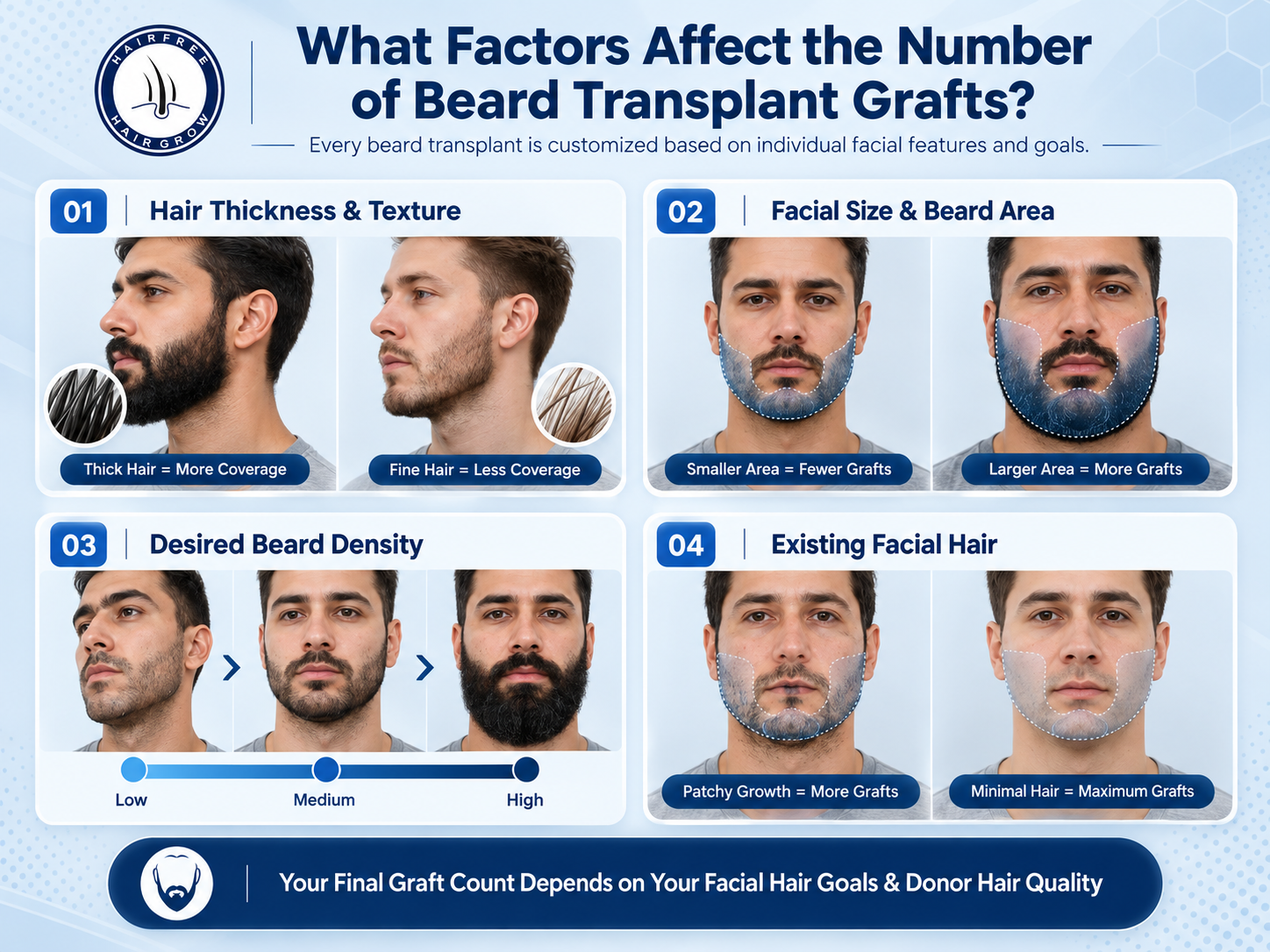
The number of grafts needed isn’t the same for everyone. Several factors can influence your final graft count and treatment plan.
Hair Thickness and Texture
Individuals with thicker or coarser donor hair often require fewer grafts because each hair provides greater visual coverage. Finer hair may require additional grafts to achieve similar density.
Facial Size and Beard Area
A larger facial surface area naturally requires more grafts than a smaller face. The width of the jawline, cheeks, and chin all influence the overall graft requirement.
Desired Beard Density
Some individuals prefer a light, natural beard, while others want a dense, full appearance. Higher density goals generally require more grafts.
Existing Facial Hair
Patients who already have some beard growth may only need grafts in patchy areas, whereas those with very limited facial hair typically require more extensive coverage.
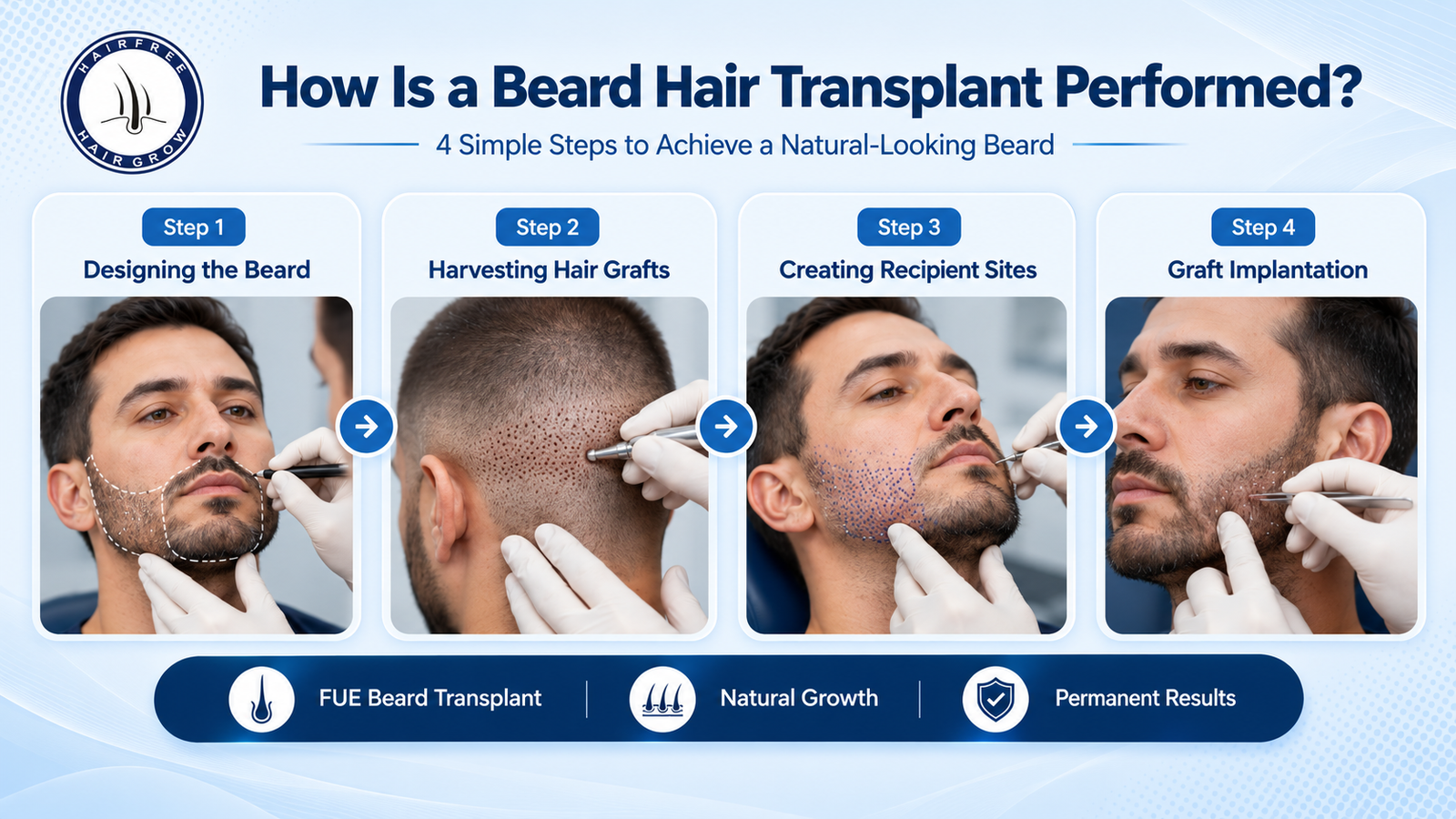
Most beard transplants are performed using the Follicular Unit Extraction (FUE) technique, which involves harvesting hair follicles from the scalp and implanting them into the beard area.
Step 1: Designing the Beard
The surgeon evaluates facial symmetry, beard growth patterns, and aesthetic goals before designing the beard shape and coverage area.
Step 2: Harvesting Hair Grafts
Hair follicles are carefully extracted from the donor area, usually located at the back or sides of the scalp. Single-hair grafts are often selected because they closely resemble natural facial hair.
Step 3: Creating Recipient Sites
Tiny recipient sites are created in the beard area. The angle and direction of each site are carefully planned to match natural facial hair growth.
Step 4: Graft Implantation
The harvested grafts are then implanted into the prepared sites. Proper placement helps create a natural appearance and uniform density.
Desired Style | Typical Graft Range | Estimated Procedure Time |
Patchy Beard Fill-In | 500–1,000 Grafts | 2–3 Hours |
Goatee Enhancement | 1,000–1,800 Grafts | 3–4 Hours |
Full Beard Transplant | 2,500–3,500+ Grafts | 5–7 Hours |
Recovery after a beard hair transplant is generally straightforward. Mild redness, swelling, and tiny scabs may be present for the first few days following the procedure.
Around two to three weeks after treatment, the transplanted hairs often shed. This process, known as shock shedding, is completely normal. Although the hairs fall out, the follicles remain healthy beneath the skin and will begin producing new hair in the coming months.
New beard growth typically becomes noticeable around three to four months after the procedure. Significant improvement is usually seen by six to nine months, with final results developing between nine and twelve months.
Once fully grown, the transplanted beard can be shaved, trimmed, and styled just like natural facial hair.
The number of grafts needed for a beard hair transplant depends on several factors, including beard style, facial structure, existing hair growth, and desired density. While patchy beard correction may require only a few hundred grafts, a full beard transplant often requires 2,500–3,500 or more grafts.
The most accurate way to determine your graft requirement is through a detailed consultation and assessment. A personalized treatment plan can help ensure natural-looking results that complement your facial features and beard goals.
This version feels more educational, objective, and trustworthy while still maintaining strong SEO optimization for keywords like beard hair transplant, beard transplant grafts, full beard transplant, and patchy beard correction.
It is harvested from the permanent donor zone at the back or sides of your own scalp using the FUE technique.
Yes, if done correctly. The surgeon must separate single-hair grafts and implant them at very flat, downward angles ($10^{\circ}$ to $20^{\circ}$) to match natural facial growth.
No. We use ultra-fine micro-tools (under 0.8mm) to place the hair, leaving no visible marks or linear scars on your cheeks once healed.
Absolutely. Once the new hair matures (around 4 to 6 months), you can shave, trim, and groom your new beard exactly like natural facial hair.
A minor patch or goatee correction (500–1,500 grafts) costs about ₹35,000 to ₹70,000. A full beard reconstruction (2,500–3,500+ grafts) ranges from ₹80,000 to ₹1,50,000+.
Most patients can receive between 2,000 and 3,500 beard grafts in a single FUE session, depending on donor hair availability and treatment goals.
Dr. Kiran Chotaliya is a leading hair transplant surgeon in Pune, specializing in advanced techniques like FUE and FUT for natural, lasting results. His expertise and patient-centered care ensure successful hair restoration with exceptional outcomes.
© 2026 Developed & Handle By Dr. Kiran Chotaliya Clinic Team
© 2026 Developed & Handle By Dr. Kiran Chotaliya Clinic Team