
Comprehensive Guide to Diagnosis and Hair Loss Treatment Women in Pune
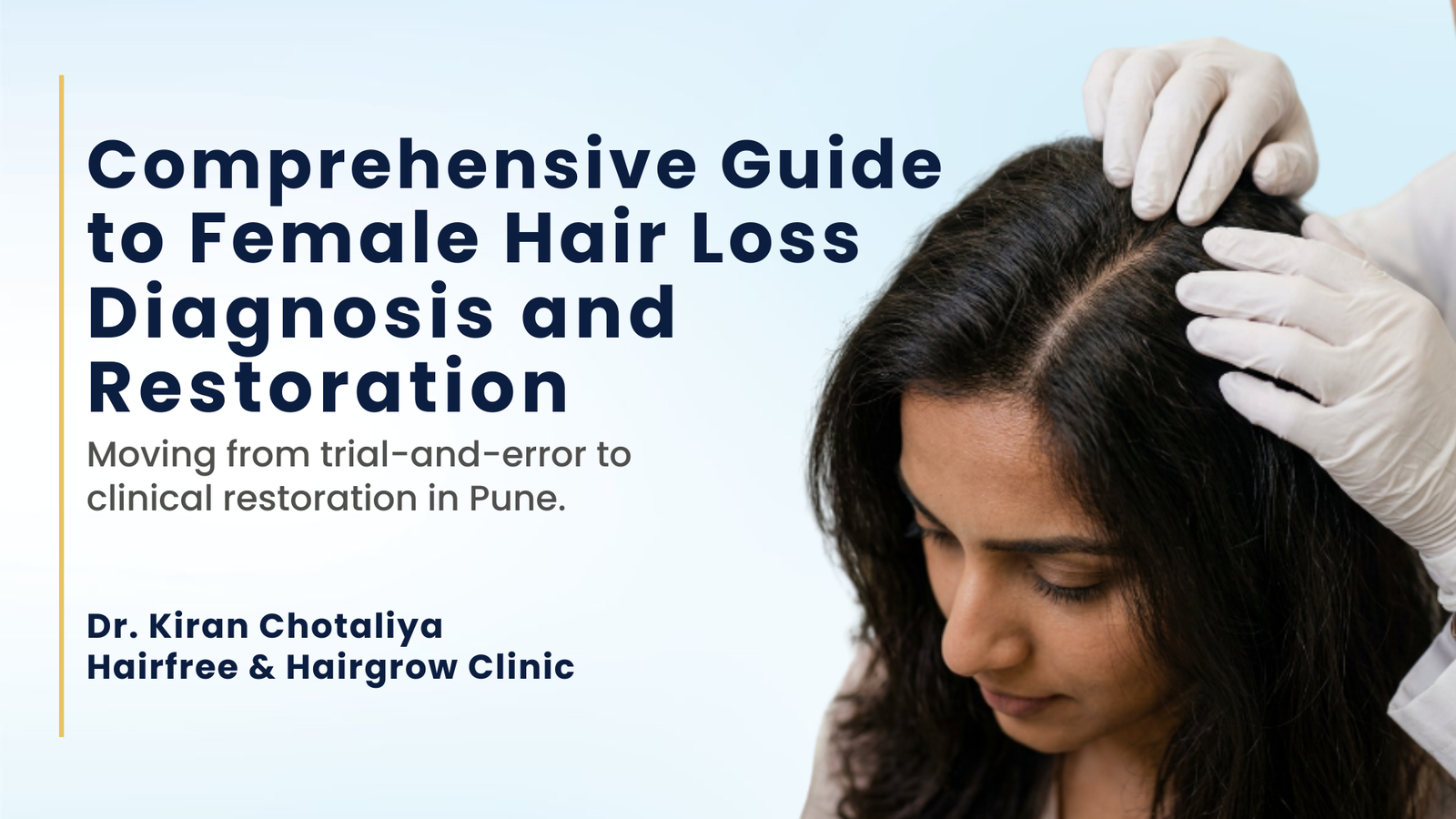
Table of Contents
Experiencing hair thinning or shedding can be an emotionally taxing experience. However, unlike male pattern baldness, female hair loss is often highly treatable once the root cause is accurately identified. If you are exploring options for hair loss treatment for women in Pune, the first and most critical step is moving away from trial-and-error home remedies and seeking a proper clinical diagnosis. In this guide, Dr. Kiran Chotaliya hair specialist Hairfree and Hairgrow clinic breaks down how female hair loss is diagnosed, common causes, and the advanced treatments available to restore your hair’s volume and your confidence.
Is Hair Transplant Permanent, Hair transplant growth after surgery, Hair Transplant In Pune, dr. kiran chotaliya clinic, Is Hair Transplant Permanent, Hair transplant growth after surgery, Hair Transplant In Pune, dr. kiran chotaliya clinic,Is Hair Transplant Permanent, Hair transplant growth after surgery, Hair Transplant In Pune, dr. kiran chotaliya clinic
Understanding Female Hair Loss: The Mirror Test
Women often notice hair loss significantly earlier than it becomes visible to others. Because female hair loss typically presents as diffuse thinning rather than a receding hairline, you can perform a few simple self-checks at home:
- Decreased Ponytail Volume: If your regular hair tie suddenly feels loose, you are likely experiencing an overall reduction in hair density.
- Widening Part Line: A central part line that becomes increasingly visible or wider—sometimes following a “Christmas tree” pattern—is a hallmark sign of Female Pattern Hair Loss (FPHL).
- Transparent Scalp: If your scalp is clearly visible under overhead lighting, you may be progressing through the stages of the Ludwig Scale, which clinicians use to measure female hair loss.

To accurately diagnose and treat female pattern hair loss, specialists utilize the Ludwig Scale, which classifies the progression into three clinical stages.
- Ludwig Grade I (Mild): Subtle thinning at the mid-scalp. Patients typically notice a widening central part, while the frontal hairline remains preserved. The primary goal at this stage is stabilization using medical therapy.
- Ludwig Grade II (Moderate): Significant density reduction is evident. The scalp becomes clearly visible under overhead lighting. The treatment goal focuses on the restoration of mid-scalp volume.
- Ludwig Grade III (Advanced): This stage features transparent scalp coverage. There is near-complete hair loss at the crown, paired with a very thin hairline. Strategic surgical redistribution is typically required for treatment.

Diagnosing the Root Cause
Effective hair loss treatment for women in Pune relies on a rigorous diagnostic workup to rule out systemic or reversible causes before any advanced procedures are considered. Women are disproportionately affected by nutritional and hormonal imbalances that can trigger or worsen shedding.
Your specialist will likely recommend a comprehensive blood panel, which should include:
- Iron Studies (Ferritin): Iron deficiency is the most common nutritional cause of hair loss in women. While standard labs have broad “normal” ranges, optimal hair growth requires ferritin levels above 70 ng/mL.
- Thyroid Function (TSH): Both an underactive and overactive thyroid can trigger diffuse, brittle hair shedding.
- Hormonal Panel: Evaluating hormones like free testosterone and DHEA-S helps identify conditions like Polycystic Ovary Syndrome (PCOS), a common driver of hair thinning.
- Vitamin D and B12: Essential for hair cycle regulation; deficiencies frequently lead to active shedding.

Top Options for Hair Loss Treatment Women in Pune
Once the cause is diagnosed, a customized treatment plan can be developed. Depending on the severity of the thinning, treatments range from medical management to advanced surgical restoration.
1. Medical and Non-Surgical Therapies
For early-stage thinning (Ludwig Grade I) or temporary shedding (Telogen Effluvium), medical stabilization is the primary goal.
- Topical & Oral Medications: Treatments like Minoxidil or physician-guided antiandrogens can shorten the hair’s resting phase and slow down progressive thinning.
- Platelet-Rich Plasma (PRP): This therapy utilizes growth factors from your own blood to speed up the follicles’ re-entry into the growth phase and support tissue repair.

2. Female Hair Transplant in Pune
For women facing permanent hair thinning, widening part lines, or traction alopecia, a Female Hair Transplant in Pune is a safe, effective, and permanent solution.
- How it Works: Healthy, DHT-resistant hair follicles are extracted from dense donor areas (usually the back of the head) and meticulously implanted into thinning areas to increase density and volume.
- Techniques (FUE vs. FUT): Specialists may use Follicular Unit Extraction (FUE), which involves minimal scarring and faster recovery, or Follicular Unit Transplantation (FUT), which is often preferred for women because it allows for a large number of grafts without requiring the donor area to be shaved.
- Natural Results: Top clinics, such as Dr. Kiran Chotaliya Clinic, focus on precise graft placement and natural hairline design to ensure the results look soft, well-balanced, and feminine.
Hair loss in women can occur due to multiple factors such as hormonal imbalance, nutritional deficiencies, stress, genetics, or medical conditions. Identifying the exact cause through proper diagnosis is the key to choosing the right treatment. From medical therapies and PRP to advanced Female Hair Transplant in Pune, modern solutions can effectively restore hair density and confidence.
If you are noticing continuous thinning, widening of the part line, or excessive shedding, consulting an experienced hair specialist early can help prevent further progression. With personalized care and advanced techniques, hair loss treatment for women in Pune can provide safe, natural-looking, and long-lasting results.
FAQ's
1. What is the cost of a Female Hair Transplant in Pune?
The cost depends on hair loss severity, number of grafts, and the technique used, such as FUE or FUT.
2. Is a Female Hair Transplant permanent?
Transplanted hair follicles are permanent and continue to grow naturally.
3.Who is the best candidate for this treatment?
Women with thinning hair, widening part lines, or permanent hair loss with a healthy donor area are ideal candidates.
4.How long does it take to see results?
Initial growth starts in 3–4 months, while full results are usually visible within 8–12 months.
5. Is the procedure safe and painful?
Yes, the procedure is safe, minimally invasive, and performed under local anesthesia with minimal discomfort.
Dr. Kiran Chotaliya MD (Skin & VD)
Our Latest Video
Hair Transplant
Hair Loss Treatment
Our Services
Latest Hair Transplant Results


Thinking about Hair Transplant?
Read this First.
A free experts curated guide that clears all your doubts
about Costs, Results, Pain, Recovery and much more.
Hair Transplant in Pune
Dr. Kiran Chotaliya is a leading hair transplant surgeon in Pune, specializing in advanced techniques like FUE and FUT for natural, lasting results. His expertise and patient-centered care ensure successful hair restoration with exceptional outcomes.
Follow Us
GET IN TOUCH
- +91 7066661143
- drkiranhairguide@gmail.com
- Dr. Kiran Chotaliya, Kate Square Building, 402, 4th floor, Chowk, Kate Puram, Pimple Gurav, Pimpri-Chinchwad, Maharashtra 411061
© 2026 Developed & Handle By Dr. Kiran Chotaliya Clinic Team
Location
© 2026 Developed & Handle By Dr. Kiran Chotaliya Clinic Team