
What to Do About a Depleted Donor Hair Supply: Causes & Solutions
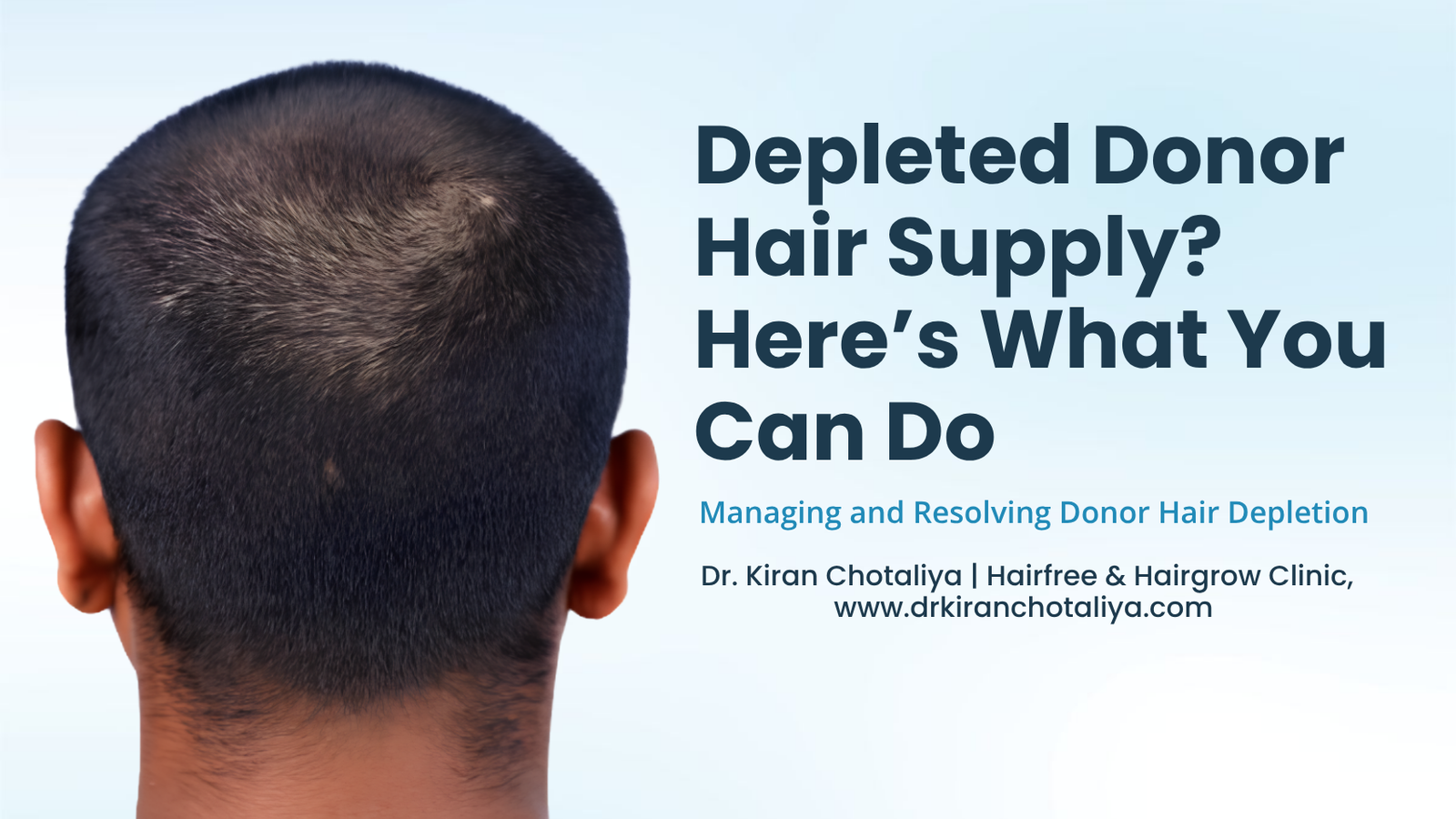
Table of Contents
A successful hair transplant relies heavily on one finite resource: your donor hair. This is the healthy hair typically found at the back and sides of your scalp that is resistant to balding. But what happens when this “bank” runs low?
A depleted donor hair supply occurs when there isn’t enough healthy hair left for further restoration. This can be a major roadblock for patients seeking additional density or correcting previous surgeries. At Dr. Kiran Chotaliya Hairfree & Hairgrow Clinic, we believe that patient education is the first step toward finding the right solution and achieving natural-looking, long-term results.
Is Hair Transplant Permanent, Hair transplant growth after surgery, Hair Transplant In Pune, dr. kiran chotaliya clinic, Is Hair Transplant Permanent, Hair transplant growth after surgery, Hair Transplant In Pune, dr. kiran chotaliya clinic,Is Hair Transplant Permanent, Hair transplant growth after surgery, Hair Transplant In Pune, dr. kiran chotaliya clinic
What Causes Donor Hair Depletion?
Understanding why the donor area is thin is essential to preventing further damage. The most common causes include:
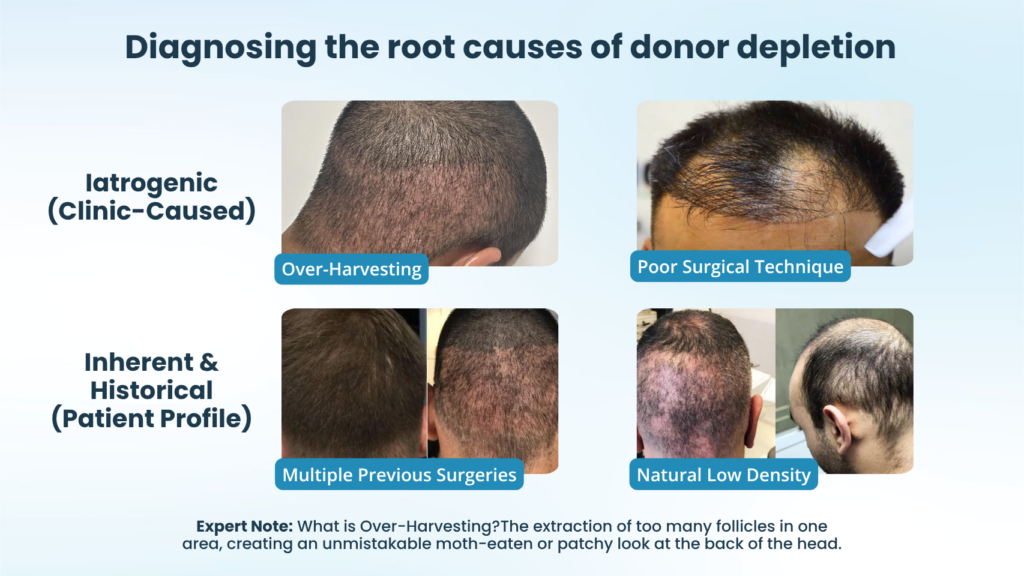
- Over-Harvesting: This is the leading cause. It occurs when too many grafts are taken from a concentrated area in a single session, leaving the scalp looking patchy or see-through.
- Poor Surgical Technique: Inexperienced handling can damage hair follicles during extraction. If the “transection rate” is high, follicles are wasted, depleting the donor zone without providing the desired coverage.
- Multiple Previous Surgeries: Every transplant session uses a portion of your lifetime donor supply. After 3 or 4 traditional sessions, the density naturally decreases.
- Natural Low Density: Some individuals are born with naturally thin donor hair, meaning they have a smaller “budget” for hair restoration from the start.
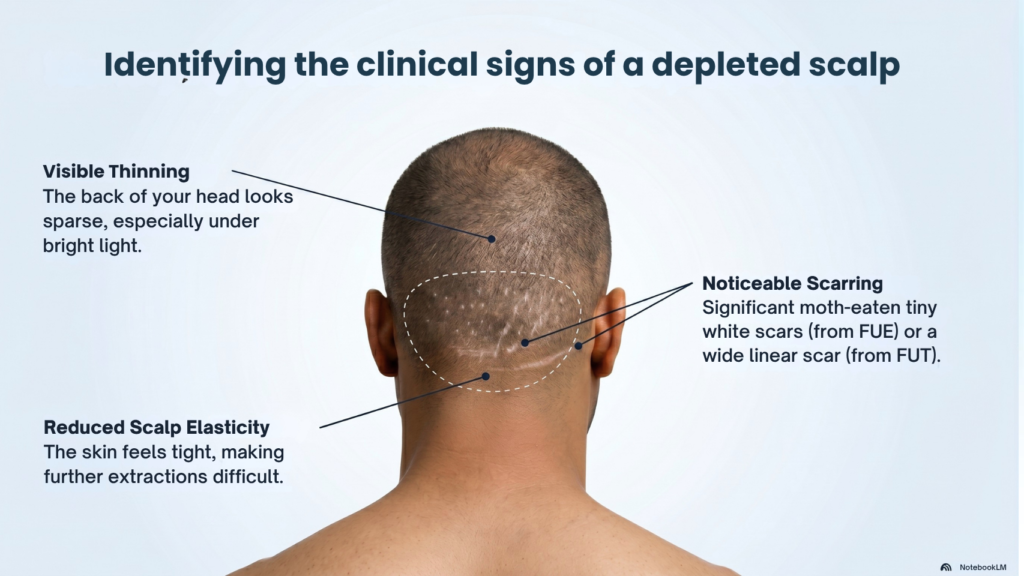
- Visible Thinning: The back of your head looks sparse, especially under bright light.
- Noticeable Scarring: Significant “moth-eaten” tiny white scars (from FUE) or a wide linear scar (from FUT).
- Reduced Scalp Elasticity: The skin feels tight, making further extractions difficult.
Advanced Solutions for Limited Donor Hair
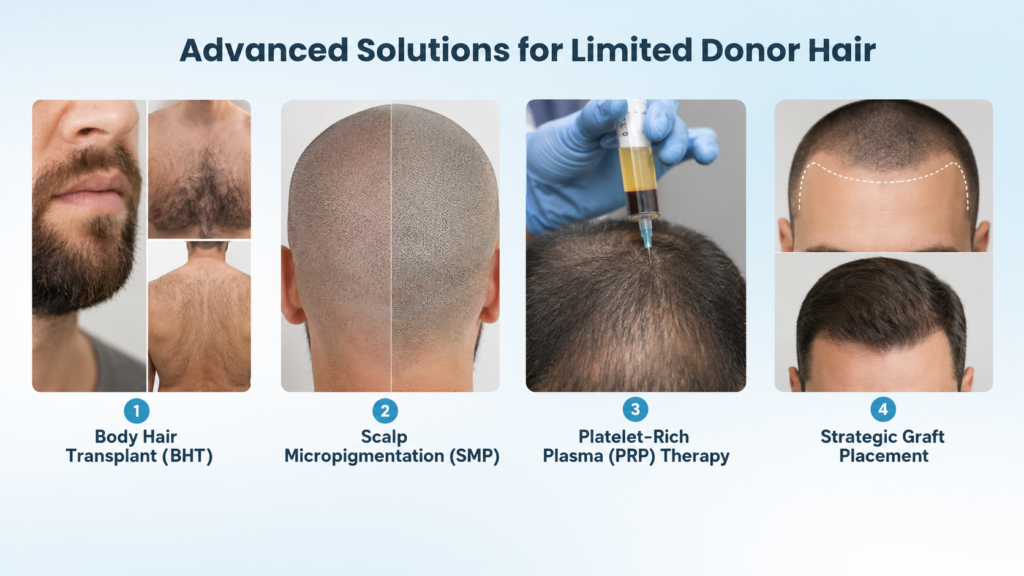
If you have been told you have a depleted donor area, do not lose hope. Modern restorative medicine offers several “Plan B” options:
1. Body Hair Transplant (BHT)
When the scalp cannot provide enough grafts, we look to other parts of the body. Beard hair is the most popular choice because it is thick, robust, and has a high survival rate. Chest or back hair can also be used to add “filler” density between existing hairs.
2. Scalp Micropigmentation (SMP)
SMP is a medical-grade “tattoo” technique that places tiny pigment dots on the scalp to mimic the look of hair follicles. For a depleted donor area, SMP can camouflage scars and create the illusion of a much thicker hair density without needing a single extra graft.
3. Platelet-Rich Plasma (PRP) Therapy
PRP involves using your own blood platelets to stimulate the scalp. While it doesn’t “grow back” a depleted donor area, it can strengthen the remaining hair and improve the overall health of the scalp, making it a vital supportive treatment.
4. Strategic Graft Placement
Sometimes, the solution isn’t more hair, but better placement. By prioritizing the frontal hairline and using available grafts where they have the most visual impact, we can create a natural look even with a limited supply.
The Importance of a Professional Evaluation
The key to avoiding or managing donor depletion is a structured, evidence-based approach. Before any procedure, a thorough evaluation of your hair density, scalp laxity, and long-term hair loss progression is mandatory.
At Hairfree & Hairgrow Clinic, we prioritize the “Donor Management” philosophy—ensuring that your donor area stays healthy for a lifetime, not just for one surgery.
Are you concerned about your donor hair density? Consult with us for a professional, medical-grade assessment of your hair restoration options.
Conclusion
A depleted donor hair supply can make hair restoration more challenging, but it does not mean your journey ends there. With advanced techniques like Body Hair Transplant (BHT), Scalp Micropigmentation (SMP), PRP therapy, and strategic graft planning, many patients can still achieve natural and satisfying results. Proper donor management, realistic expectations, and choosing an experienced hair transplant surgeon are the keys to long-term success. At Dr. Kiran Chotaliya Hair Transplant Clinic, every case is carefully evaluated to create a personalized treatment plan that protects your remaining donor area while maximizing visible coverage and density.
FAQ's
1. Can a depleted donor area be fully restored?
No, hair follicles removed from the donor area do not grow back. However, the appearance can be improved through SMP or by thickening remaining hair with PRP.
2. Is body hair as good as scalp hair for transplants?
Beard hair is the most effective scalp hair substitute due to its thickness. Other body hair (chest/back) is typically used for filling density rather than defining a hairline.
3. How many grafts can safely be taken from the donor area?
On average, a healthy scalp has about 6,000 to 8,000 donor grafts available over a lifetime. Exceeding this limit leads to visible thinning.
4. Does PRP help with donor area depletion?
PRP cannot create new follicles, but it can strengthen existing ones and improve scalp health, making the remaining hair appear fuller.
5. What is "over-harvesting"?
Over-harvesting is the extraction of too many follicles in one area, creating a “moth-eaten” or patchy look at the back of the head.
Dr. Kiran Chotaliya MD (Skin & VD)
Our Latest Video
Hair Transplant
Hair Loss Treatment
Our Services
Latest Hair Transplant Results


Thinking about Hair Transplant?
Read this First.
A free experts curated guide that clears all your doubts
about Costs, Results, Pain, Recovery and much more.
Hair Transplant in Pune
Dr. Kiran Chotaliya is a leading hair transplant surgeon in Pune, specializing in advanced techniques like FUE and FUT for natural, lasting results. His expertise and patient-centered care ensure successful hair restoration with exceptional outcomes.
Follow Us
GET IN TOUCH
- +91 7066661143
- drkiranhairguide@gmail.com
- Dr. Kiran Chotaliya, Kate Square Building, 402, 4th floor, Chowk, Kate Puram, Pimple Gurav, Pimpri-Chinchwad, Maharashtra 411061
© 2026 Developed & Handle By Dr. Kiran Chotaliya Clinic Team
Location
© 2026 Developed & Handle By Dr. Kiran Chotaliya Clinic Team