Female Hair Transplant in Pune for Women Near Kharadi
Table of Contents
Hair loss is a growing concern among women, affecting their appearance, confidence and emotional well-being. Widening hair partitions, reduced hair volume, receding hairlines and visible scalp areas are common concerns experienced by women of different age groups.
Genetic predisposition, hormonal changes, nutritional deficiencies, thyroid disorders and ageing can contribute to female hair thinning. Fortunately, advances in medical and surgical hair restoration have introduced several treatment options for women experiencing persistent hair loss.
If you are considering a Female Hair Transplant in Pune, especially if you live in Kharadi, a professional consultation can help determine the underlying cause of your hair loss and the most suitable treatment approach.
At Hairfree & Hairgrow Clinic, Dr. Kiran Chotaliya provides personalised hair restoration solutions using modern techniques, including FUE, based on individual hair loss patterns, donor hair availability and aesthetic goals.
Understanding Female Hair Loss
Unlike male pattern baldness, female hair loss frequently appears as gradual thinning across the scalp rather than complete baldness in specific areas.
Women may notice reduced ponytail thickness, a widening central parting or increased scalp visibility over time.
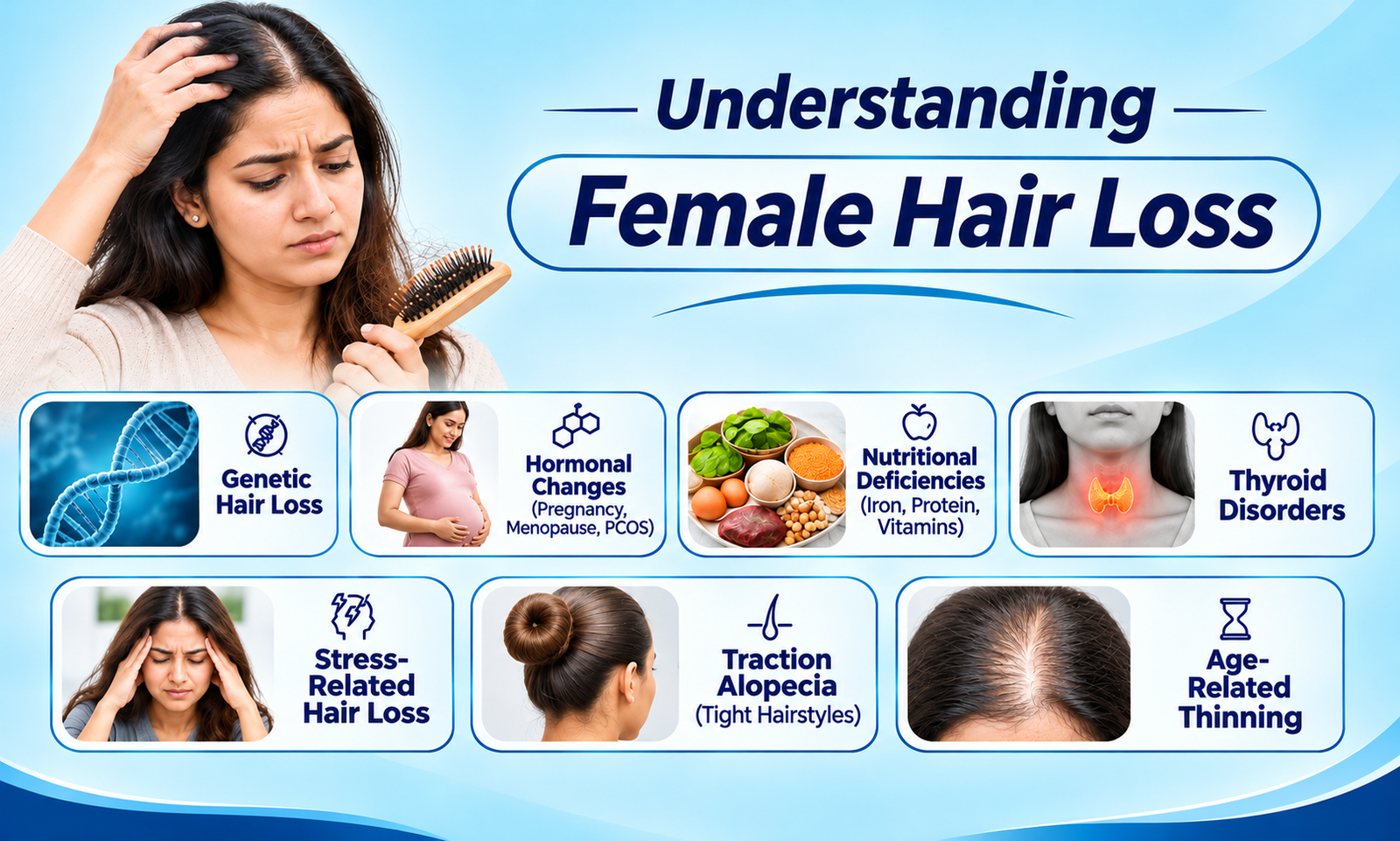
Common causes of female hair loss include:
- Genetic hair loss: Hereditary factors can contribute to progressive follicular miniaturisation and reduced hair density.
- Hormonal changes: Pregnancy, menopause and conditions such as PCOS may influence hair growth.
- Nutritional deficiencies: Iron, protein and vitamin deficiencies can contribute to excessive hair shedding.
- Thyroid disorders: An underactive or overactive thyroid may disrupt the natural hair growth cycle.
- Stress-related hair loss: Physical and emotional stress can trigger temporary hair shedding.
- Traction alopecia: Frequently wearing tight hairstyles may damage hair follicles over time.
- Age-related thinning: Hair follicles may gradually produce finer and shorter hair with increasing age.
Identifying the exact cause is essential before recommending surgical hair restoration.
What Is a Female Hair Transplant?
A female hair transplant in pune is a surgical hair restoration procedure in which healthy hair follicles are collected from a suitable donor region and implanted into areas experiencing permanent hair thinning or baldness.
The procedure aims to improve scalp coverage, restore hairline appearance and achieve natural-looking hair growth.
A female hair transplant may help address:
- Widening central hair partition.
- Permanent crown-area thinning.
- Receding frontal hairline.
- Thinning around the temples.
- Localised permanent bald patches.
- Selected cases of stable traction alopecia.
Women with healthy and stable donor hair may benefit from this procedure after appropriate medical evaluation.
Female Hair Transplant Myths and Facts
Many women hesitate to consider surgical hair restoration because of common misconceptions. Understanding the facts can help patients make informed decisions.
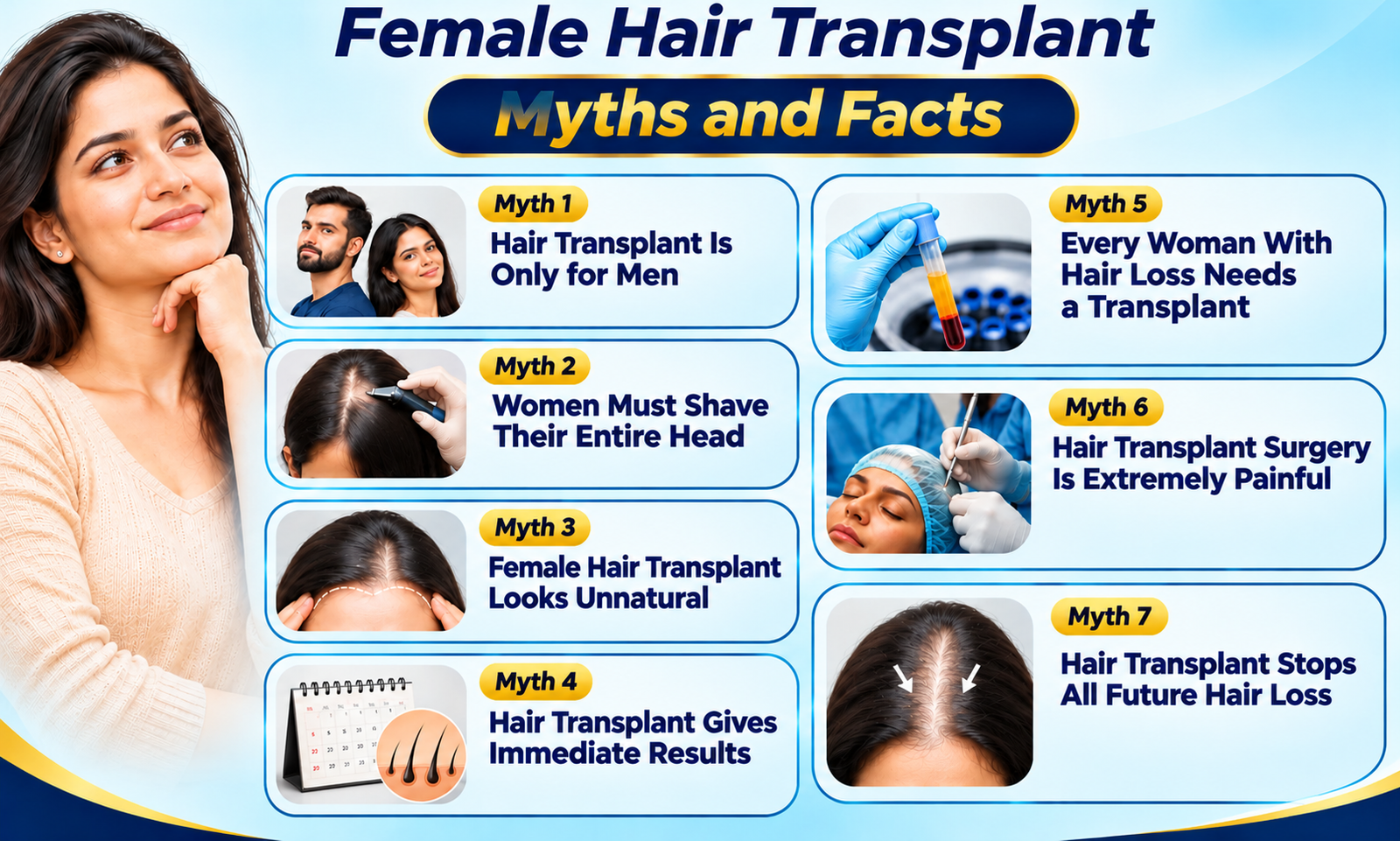
Myth 1: Hair Transplant Is Only for Men
Fact: Women can also undergo hair transplantation.
Although Male Hair Transplant in Pune is widely known, surgical hair restoration is also available for suitable female patients experiencing permanent hair loss.
Myth 2: Women Must Shave Their Entire Head
Fact: Complete head shaving is not always necessary.
Depending on the technique and graft requirements, selected women may undergo hair transplantation with limited donor-area trimming, allowing surrounding long hair to conceal the treated region.
Myth 3: Female Hair Transplant Looks Unnatural
Fact: Modern hair transplantation focuses on natural hair growth patterns.
Careful attention to hair direction, implantation angle, facial proportions and hairline design may help achieve natural-looking results.
Myth 4: Hair Transplant Gives Immediate Results
Fact: Hair restoration is a gradual biological process.
New hair growth generally begins after three to four months, with progressive improvements over the following months.
Myth 5: Every Woman With Hair Loss Needs a Transplant
Fact: Many women benefit from non-surgical treatment.
Hair loss associated with nutritional deficiencies, hormonal imbalances or temporary shedding may respond to medical management. Surgery is generally considered when the diagnosis and donor hair quality support it.
Myth 6: Hair Transplant Surgery Is Extremely Painful
Fact: Hair transplantation is generally performed under local anaesthesia.
Patients may experience mild discomfort, swelling or scalp tenderness during recovery, which can usually be managed with appropriate postoperative care.
Myth 7: Hair Transplant Stops All Future Hair Loss
Fact: Existing non-transplanted hair may continue thinning.
Long-term medical management and regular follow-ups may be necessary to maintain overall hair density.
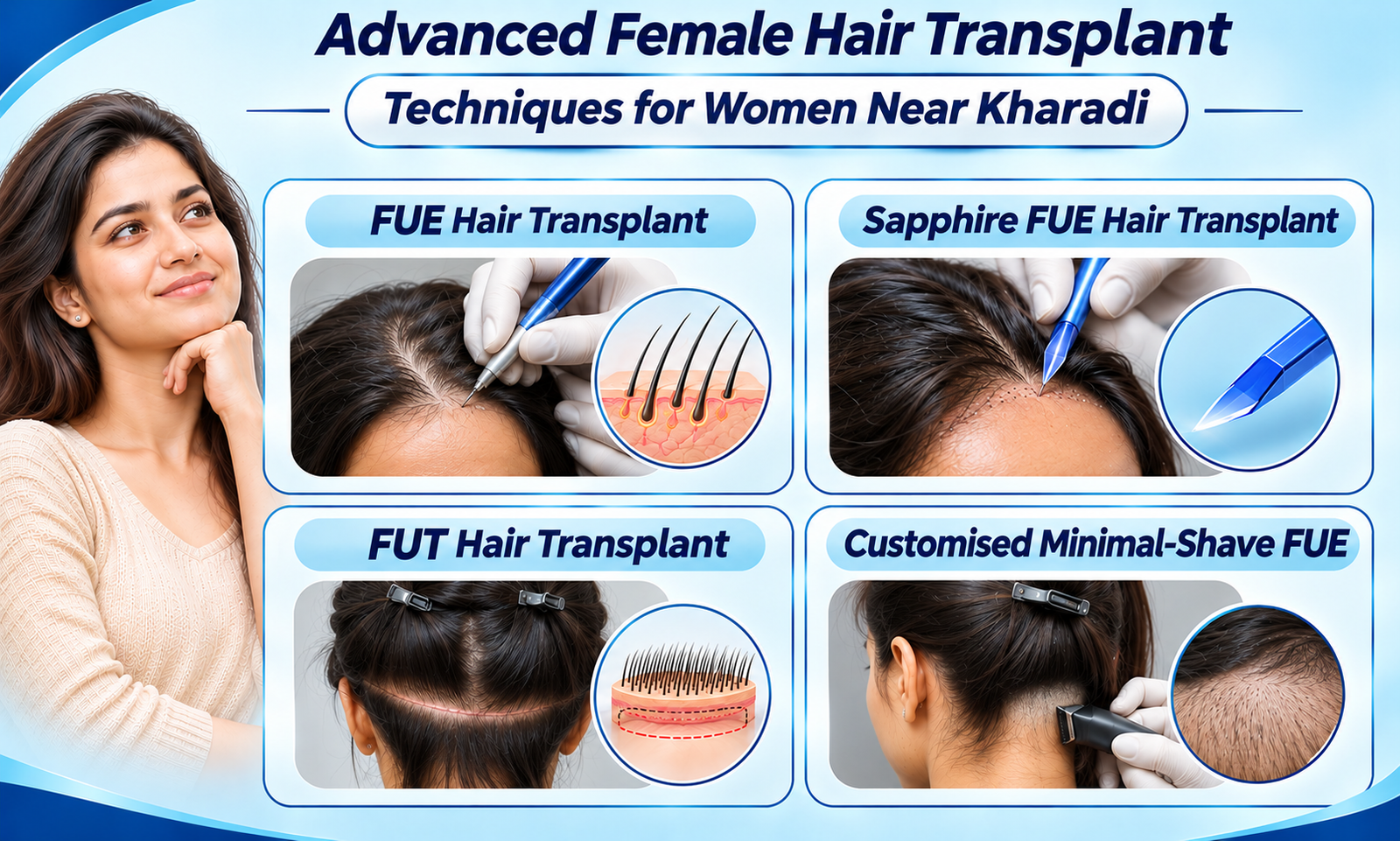
Advanced Female Hair Transplant Techniques for Women Near Kharadi
1. FUE Hair Transplant
Follicular Unit Extraction (FUE) involves harvesting individual hair follicular units from a suitable donor region and implanting them into areas requiring additional coverage.
Potential benefits include:
- No long linear donor scar.
- Small individual extraction sites.
- Personalised graft placement.
- Natural-looking hairline planning.
- Improved coverage in selected thinning areas.
- Relatively comfortable donor-area recovery.
2. Sapphire FUE Hair Transplant
Sapphire FUE uses specialised sapphire blades to create recipient channels during hair transplantation. The technique allows the surgeon to plan graft direction, angle and distribution according to the patient’s requirements.
Results depend on surgical execution, donor hair quality and individual healing rather than the blade material alone.
3. FUT Hair Transplant
Follicular Unit Transplantation (FUT) involves removing a narrow strip of hair-bearing scalp and separating it into individual follicular units.
For selected women with long hair, the linear donor scar may be concealed beneath surrounding hair. The suitability of FUT depends on individual scalp characteristics and restoration goals.
4. Customised Minimal-Shave FUE
Women concerned about shaving may explore customised FUE procedures involving limited trimming of the donor area.
This approach may be suitable for selected patients requiring targeted hairline correction or localised density improvement.
Male vs Female Hair Transplant: Key Differences
Although the basic principles of transplantation are similar, female hair restoration requires a different clinical and aesthetic approach.
Factors | Male Hair Transplant | Female Hair Transplant |
Hair loss pattern | Receding hairline and crown baldness | Diffuse thinning and widening parting |
Hairline design | Masculine, structured hairline | Soft, natural feminine hairline |
Donor area | Often more clearly defined | Requires careful stability assessment |
Treatment goal | Bald-area coverage and hairline restoration | Improved volume and scalp coverage |
Shaving requirements | Often recommended | Limited shaving may be possible |
Medical evaluation | Hair loss and donor assessment | May also require hormonal and nutritional evaluation |
Treatment planning | Based on baldness progression | Based on diagnosis, density and donor stability |
Whether you are considering a male or female Hair Transplant in Pune, personalised medical assessment is essential for appropriate treatment planning.
Who Is an Ideal Candidate for Female Hair Transplant?
Women may be suitable candidates for hair transplantation if they have:
- Persistent female pattern hair loss with a stable donor region.
- Permanent frontal hairline recession.
- Noticeable thinning around the crown or central partition.
- Healthy donor hair at the back or sides of the scalp.
- Stable hair loss following appropriate medical management.
- Realistic expectations regarding hair density and coverage.
- Good overall health and suitable scalp conditions.
Women with active inflammatory scalp disease, temporary hair shedding or significant thinning throughout the donor region may require alternative treatment instead of surgery.
Female Hair Transplant Procedure: Step-by-Step Process
Step | Procedure | Description |
Step 1 | Consultation and scalp analysis | Evaluation of hair loss, medical history and donor hair quality. |
Step 2 | Medical assessment | Investigation of possible hormonal, nutritional and underlying medical concerns when indicated. |
Step 3 | Hairline design | Personalised planning based on facial proportions and existing hair patterns. |
Step 4 | Donor hair extraction | Collection of suitable follicular units under local anaesthesia. |
Step 5 | Recipient site creation | Preparation of implantation sites according to natural hair direction. |
Step 6 | Graft implantation | Careful placement of follicles into the targeted areas. |
Step 7 | Postoperative care | Recovery guidance, prescribed medications and follow-up consultations. |
Benefits of Female Hair Transplant in Pune
- Improved Hair Density: May improve visible hair coverage in suitable thinning areas.
- Natural Hairline Restoration: Supports the reconstruction of a softer, age-appropriate feminine hairline.
- Long-Term Hair Growth: Successfully transplanted follicles may continue producing hair for many years.
- Personalised Hair Restoration: Treatment can be customised according to individual hair loss patterns and cosmetic goals.
- Improved Hairstyling Options: Better scalp coverage may allow greater flexibility in everyday hairstyling.
- Improved Self-Confidence: Restored hair coverage may positively influence appearance and emotional well-being.
- Targeted Treatment: Surgical planning focuses on areas requiring additional density while preserving available donor hair.
Female Hair Transplant Recovery and Growth Timeline
Time Period | Expected Hair Growth and Recovery |
First week | Initial scalp healing, mild redness and scab formation. |
10–14 days | Gradual reduction in scabbing and postoperative discomfort. |
2–8 weeks | Temporary shedding of transplanted hair shafts may occur. |
3–4 months | Early new hair growth begins in many patients. |
6 months | Noticeable improvements in hair coverage may develop. |
9 months | Progressive improvement in hair thickness and density. |
12–18 months | Continued maturation of transplanted hair and cosmetic results. |
Recovery varies depending on scalp health, surgical technique, individual healing and postoperative care.
Non-Surgical Hair Restoration for Women in Pune
Hair transplantation is one component of comprehensive female hair restoration. Depending on the underlying diagnosis, a dermatologist may recommend non-surgical treatments before or alongside transplantation.
PRP Therapy
Platelet-Rich Plasma therapy involves using concentrated platelets prepared from the patient’s blood to support hair growth in selected cases of pattern hair loss.
GFC Therapy
Growth Factor Concentrate therapy uses growth factors derived from the patient’s blood. It may be considered as a supportive hair restoration treatment, although clinical evidence is still developing.
Medication Treatment
Dermatologist-prescribed medications may help manage progressive hair thinning and support existing hair follicles.
Low-Level Laser Therapy
LLLT uses low-level light energy to support follicular activity and may improve hair density in selected patients.
Nutritional and Hormonal Management
Identifying and treating underlying deficiencies, thyroid disorders or hormonal conditions may help reduce excessive hair shedding when these are contributing factors.
Female Hair Transplant Cost in Kharadi Pune
The cost of female hair transplantation varies according to individual requirements. There is no fixed price that applies to every patient.
Important factors influencing the cost include:
- Extent and severity of hair loss.
- Number of grafts required.
- Selected surgical technique.
- Donor hair quality and availability.
- Minimal-shave or customised surgical requirements.
- Number of surgical sessions.
- Preoperative medical investigations.
- Postoperative treatment and follow-up care.
- Experience of the treating surgeon and clinical facilities.
A personalised consultation with Dr. Kiran Chotaliya can help determine the anticipated graft requirement and provide an individual treatment estimate.
Why Choose Dr. Kiran Chotaliya for Female Hair Transplant Near Kharadi?
Choosing an appropriately qualified hair restoration specialist is important for diagnosis, treatment planning and long-term hair management.
At Hairfree & Hairgrow Clinic, Dr. Kiran Chotaliya’s approach includes:
- Comprehensive Hair and Scalp Evaluation: Identification of the underlying causes of female hair loss.
- Advanced FUE Techniques: Selection of suitable surgical approaches based on clinical requirements.
- Personalised Feminine Hairline Design: Planning hairlines that complement facial structure and natural hair patterns.
- Donor Area Preservation: Careful assessment and extraction planning to protect available donor follicles.
- Individualised Medical Management: Addressing nutritional, hormonal and other contributing factors when appropriate.
- Modern Clinical Facilities: Dedicated surgical facilities and sterilisation protocols.
- Post-Treatment Support: Recovery guidance, follow-up assessments and long-term hair maintenance.
Women from Kharadi, Viman Nagar, Wagholi, Hadapsar, Magarpatta and surrounding areas of Pune can consult Dr. Kiran Chotaliya at Hairfree & Hairgrow Clinic in Pimple Gurav, Pimpri-Chinchwad.
Conclusion
Female hair loss can be challenging, but modern medical and surgical hair restoration techniques offer several potential treatment options. From early-stage hair thinning to permanent hairline recession, personalised assessment can help identify the most appropriate treatment approach.
If you are exploring a Female Hair Transplant in Kharadi Pune, consult Dr. Kiran Chotaliya at Hairfree & Hairgrow Clinic to understand your hair loss condition, available donor hair, treatment options and realistic expected outcomes.
Whether you are searching for a Hair Transplant in Pune, Male Hair Transplant in Pune or advanced Female Hair Transplant, professional guidance can help you make an informed decision about your hair restoration journey.
FAQs
1. Is female hair transplant permanent?
Successfully transplanted follicles from a stable donor region may continue growing for many years. However, existing non-transplanted hair may require ongoing medical management.
2. Can women undergo hair transplantation without shaving their heads?
Yes. Selected women may be suitable for minimal-shave FUE techniques, depending on donor hair characteristics and the number of grafts required.
3. What is the cost of a female hair transplant in Pune?
The cost depends on the extent of hair loss, graft requirements, surgical technique and personalised treatment plan. A consultation is necessary for an accurate estimate.
4. Can a female hair transplant improve a widening hair partition?
Yes, suitable women with permanent patterned thinning and healthy donor hair may benefit from transplantation to improve central scalp coverage.
5. How long does it take to see female hair transplant results?
Initial growth may begin within three to four months, with visible improvements around six to nine months. Mature cosmetic results may take 12–18 months.